
Restaurant acoustics: improving comfort and controlling noise
In bars and restaurants, noise has become one of the leading causes of customer dissatisfaction. Overlapping conversations, overwhelming sound environments, difficulty exchanging — these situations quickly degrade the overall experience.
Working on restaurant acoustics is therefore essential. Beyond comfort, it directly influences customer loyalty, the image of the venue, and working conditions for staff. When properly managed, it can transform a noisy space into a welcoming and pleasant environment.

A real challenge in dining spaces
In a restaurant, noise results from a combination of phenomena: customer interactions, foot traffic, equipment, or external disturbances. These sounds accumulate and quickly create an atmosphere that is difficult to control.
Customer expectations are high:
- 81% of French people avoid too noisy dining venues
- The #1 customer complaint: noise from other tables (60%)
- Other sources of discomfort: outside traffic (33%), noise from restrooms (31%)
The result: sound ambiance has become a determining factor in the overall perception of a restaurant.
A direct impact on loyalty and experience
A poorly controlled sound environment has immediate consequences:
- 54% of customers give up entering a noisy venue
- 29% leave after being seated
- 53% do not return after a bad experience
- 16% leave after ordering
On the contrary, a calm atmosphere makes a real difference:
- 94% of customers say they would return more easily to a quiet venue
Noise also affects staff, with significant consequences:
- 76% of customers believe restaurant professionals are impacted by noise
- Among staff: 86% experience extra fatigue, 63% risk of hearing loss, 60% risk of depression
Restaurant acoustics thus becomes a key lever for improving both the customer experience and the overall performance of the venue.
Understanding acoustics in a restaurant
In a dining room, hard surfaces reflect sound. Without proper treatment, sounds accumulate and create a permanent background noise.
Two elements are essential:
- Acoustic absorption: reducing reverberation
- Acoustic insulation: limiting noise propagation
Acoustic quality relies on several indicators:
- Absorption coefficient (αw)
- Equivalent absorption area (EAA)
- Reverberation time (Tr)
- Sound decay in space (D2,s)
Without control, everyone raises their voice to be heard — known as the Lombard effect — which further amplifies the noise level.
The NF S31-299 standard: a framework for controlled spaces
To structure the approach, the NF S31-299 standard provides benchmarks adapted to dining establishments.
It distinguishes several levels of sound ambiance: calm, lively, noisy, and very noisy, and provides indicators to size acoustic treatment accordingly.
Ambiance | EAA | Tr | D2,s |
Calm | ≥ 1.50 Ssol | ≤ 0.5 s | ≥ 5 dB |
Lively | ≥ 0.75 Ssol | ≤ 0.8 s | ≥ 3 dB |
Noisy | ≥ 0.25 Ssol | ≤ 2.5 s | ≥ 1.5 dB |
This framework makes it possible to adapt solutions according to the actual use of the venue and the desired level of comfort.
What solutions are available to improve restaurant acoustics?
Solutions designed for dining environments
Some acoustic solutions combine performance with architectural integration:
- Tonga® A: Class A acoustic absorption, wide range of design options
- Tonga® dB A: balance between absorption and insulation, ideal for spaces requiring confidentiality
- Quick-Lock® Insula: modular island system, flexible and easy to install
These solutions improve acoustics while respecting the identity of the venue.
A concrete example: controlled ambiance at Le Magnetic restaurant
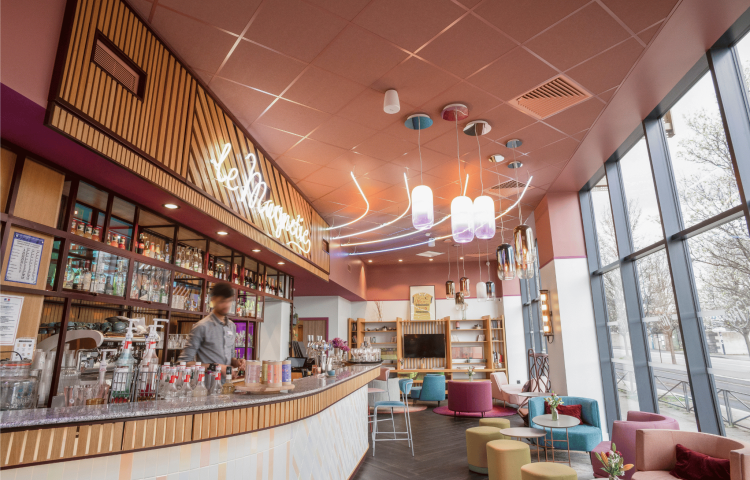
At the Le Magnetic hotel restaurant in Clermont-Ferrand, the integration of acoustic solutions in the ceiling transformed the sound environment.
The project achieved:
- Reduced reverberation
- Improved speech intelligibility
- A preserved warm atmosphere
This case illustrates the value of integrating acoustics from the design stage to create a space that is both aesthetically pleasing and comfortable.