
Suspended ceiling: design and installation in a tertiary sector environment, best practices
In professional environments, ceilings are no longer limited to a simple finishing element. The suspended ceiling plays a central role in space organization by integrating technical systems, improving acoustic comfort, and contributing to the overall quality of the building.
Eurocoustic modular ceiling solutions fully align with this approach, providing performance tailored to the requirements of tertiary sector environments.
In offices, healthcare facilities, or educational spaces, the design and installation of modular ceilings must meet specific constraints. A poorly anticipated system can impact maintenance, performance, or the evolution of spaces.
Understanding how to design and install a suspended ceiling in tertiary environments with Eurocoustic solutions therefore ensures a sustainable balance between usage, technical requirements, and performance.

A key structural element in commercial spaces
In commercial projects, requirements vary depending on usage:
Offices: space organization and working comfort
Education: listening quality and intelligibility
Healthcare: hygiene and ease of maintenance
Retail: readability of spaces and user experience
In these contexts, the Eurocoustic suspended ceiling addresses several key challenges:
- visually structuring spaces
- integrating technical equipment
- facilitating operation and maintenance
- contributing to building performance
It therefore constitutes a key element in the overall design of a professional environment.
Understanding how a modular suspended ceiling works
This system is based on three main elements:
- a suspended metal framework
- demountable modular tiles
- a technical plenum allowing the routing of building services
The plenum plays an essential role: it allows the integration of equipment (lighting, ventilation, cabling) while ensuring easy access for maintenance operations.

Design a suspended ceiling adapted to the project's constraints
Design is a crucial stage. It determines both the ceiling’s performance and its ability to evolve over time, particularly with Eurocoustic systems.
Acoustic performance is also a key factor, especially for improving sound comfort and the quality of interactions in professional spaces.
In this context, several criteria must be considered:
- available height and plenum depth
- type of use (focus work, circulation, public reception)
- environmental constraints (humidity, cleanability)
- regulatory requirements (fire reaction, acoustics)
The choice of solutions directly impacts performance in terms of:
- acoustic absorption
- light reflection
- strength and durability
Installing a suspended ceiling: principles and key steps
1. Coordination and integration of technical systems
a. Plan the routing of technical networks (HVAC, electrical, fire safety systems) within the plenum, ensuring consistency with modular ceiling systems such as Eurocoustic.
b. Ensure close coordination with technical trades to limit installation conflicts and guarantee compatibility with the grid system and tiles.
c. Check openings and accessibility of technical areas to enable efficient maintenance of equipment integrated into the ceiling.
2. Layout and installation of the grid system
a. Review the execution drawings and validate their compatibility with the selected Eurocoustic solutions.
b. Mark the finished ceiling level using a laser, taking into account the specific constraints of the modular ceiling system.
c. Position the hangers according to the defined ceiling height and allowable loads.
d. Install the grid system (T15, T24, or T35 profiles compatible with Eurocoustic solutions) in compliance with project requirements and technical recommendations.
3. Installation of ceiling tiles
a. Follow the layout plan and installation direction defined for the tiles to ensure acoustic performance and aesthetics.
b. Install Eurocoustic modular tiles onto the grid, ensuring correct positioning.
c. Integrate technical equipment (luminaires, air diffusers, detectors) directly into the tiles by making the necessary cut-outs according to the planned layout.
d. Make perimeter cuts to ensure a consistent finish and visual continuity.
e. Check the alignment, stability, and final appearance of the installed tiles.

Assembly of an Eurocoustic Quick-Lock Clip-On frame
Concrete benefits for users and operations
A well-designed and properly installed Eurocoustic suspended ceiling provides visible day-to-day benefits:
- improved acoustic comfort
- better management of technical equipment
- easier access for maintenance and interventions
- adaptability to changing uses
- consistent aesthetic integration
These advantages are particularly important in high-traffic environments.
Applications across all professional environments
Eurocoustic modular suspended ceilings are suitable for a wide range of tertiary environments:
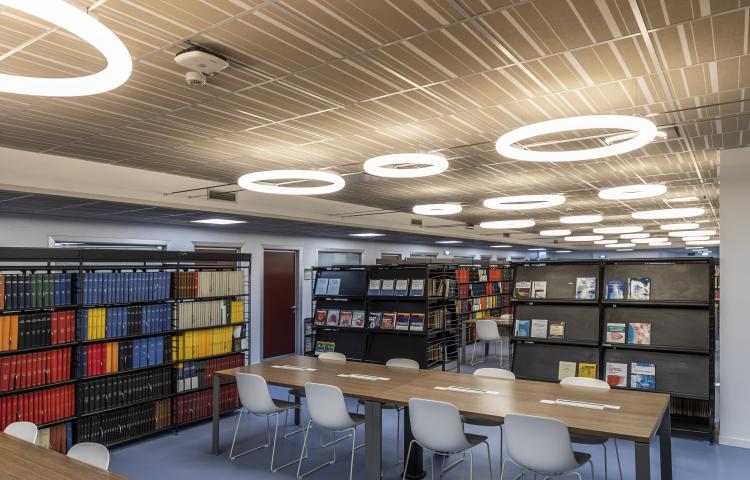
- in offices, to organize workspaces
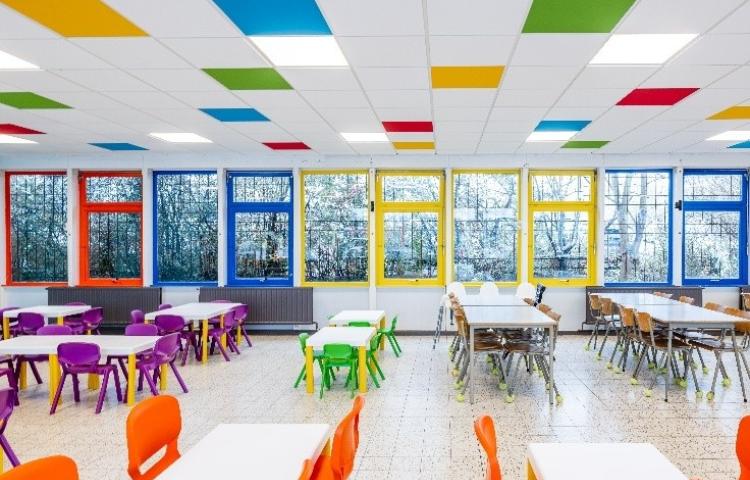
- in educational facilities, to improve listening conditions
- in healthcare settings, to meet hygiene requirements
- in retail and public spaces, to structure volumes
Each project requires a specific combination of design and installation.
Designing a high-performance, durable suspended ceiling
Designing and installing a suspended ceiling in a tertiary environment relies on a comprehensive approach that combines technical constraints, usage requirements, and performance.
Eurocoustic solutions address these challenges by offering modular systems that are reliable, high-performing, and suited to professional environments.
The suspended ceiling thus becomes a real design lever, supporting comfort, functionality, and the overall quality of the spaces.