
Office acoustic comfort: improving privacy and well-being
In open workspaces, noise and lack of privacy have become major challenges. Conversations, phone calls, sound circulation… all factors that disrupt concentration and the quality of exchanges.
Improving acoustic comfort in offices is no longer just an added bonus: it is an essential lever for performance, well-being, and collective efficiency.
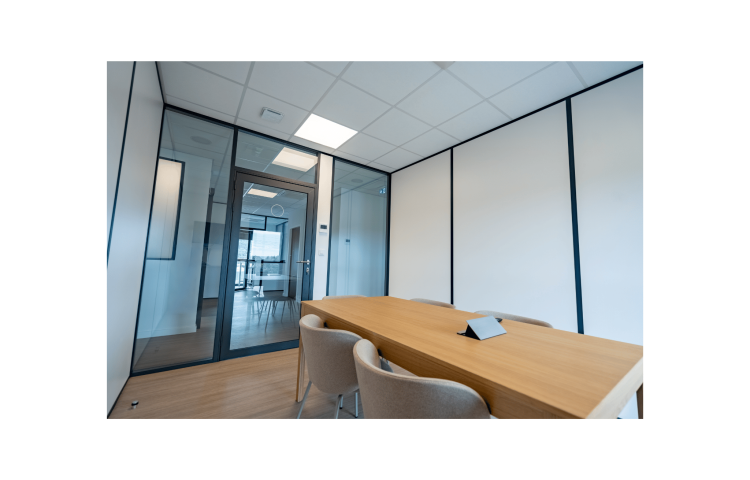
In Bollène, at the Saint-Gobain Valoref site, an office acoustic fitting project concretely illustrates how to transform a work environment by integrating tailored solutions.

Noise and privacy: major challenges in open-plan offices
In collective offices, acoustic quality directly influences working conditions. When sound is not controlled, it quickly becomes a source of disruption: difficulty concentrating, fatigue, less effective exchanges.
Data from an OpinionWay* study highlights these impacts:
- 59% of employees feel they lose efficiency due to noise
- 58% experience difficulty concentrating
- 51% report increased fatigue or headaches
Noise thus becomes a determining factor in quality of life at work, but also in the overall performance of teams.
Understanding acoustic challenges in workspaces
In an open-plan office, sounds travel easily and reflect off surfaces, amplifying the nuisance. Two main issues need to be addressed:
- Reverberation, which creates ambient noise
- Sound propagation, which reduces privacy between workstations or zones
The NF ISO 22955 standard – Acoustic quality of open-plan offices provides a reference framework for designing high-performing work environments by integrating these challenges from the outset.
It particularly emphasises the importance of controlling the sound environment to ensure working conditions suited to current uses.
Complementary solutions for treating office acoustics
To effectively improve acoustic comfort, it is essential to combine several solutions tailored to the space and its uses.
In the Valoref project, two main levers were implemented:
- a suspended acoustic ceiling
- acoustic office partitions

Performances tailored to work environments
Acoustic partitions to reinforce privacy
The Clipper Coramine acoustic partitions play a key role in organising workspaces and managing privacy, combining solid and glazed modules to balance acoustic insulation and natural light.
They make it possible to:
- limit sound propagation
- improve the privacy of exchanges
- structure spaces without fully partitioning them
Insulation performance:
- up to 41 dB for solid partitions
up to 42 dB for double-glazed partitions
A high-performance acoustic ceiling to tackle noise
The Tonga® dB 41 A acoustic ceiling combines absorption and insulation to effectively treat noise.
- Absorption: Class A (αw = 0.90)
- Insulation: 41 dB (Dnfw)
- Light reflectance: 87%
These performances reduce sound nuisance while preserving bright and comfortable spaces.
A concrete project: the Valoref site in Bollène
At the Valoref site, the objective was clear: improve acoustic comfort while respecting architectural and lighting constraints.
The combination of acoustic ceilings and modular partitions made it possible to create spaces that are:
- quieter
- better organised
- better suited to professional exchanges
As Isabelle Renovell, Marketing and Digital Communication Manager at Valoref, highlights:
"Honestly, we are delighted with your solutions. We are in a large building and most of the time, we have the impression there is no one there."
This feedback illustrates the concrete impact of acoustic treatment on day-to-day experience.

Higher-performing offices through controlled acoustics
PROJECT INFORMATION
Project : Valoref
Segment: Offices
Country / City: France, Bollène
Produit : Tonga® dB 41 A, Clipper Coramine acoustic partition
Photographer : Thierry Amrhein
Year of completion : 2025
*Source – Saint-Gobain Ecophon / OpinionWay study, December 2021